
This article is part of our retirement planning education series.
Retirement is approaching, and it’s time to start thinking about income without a full-time job. One of the income sources that’ll provide a steady, predictable stream of monthly income: Social Security.
By now, you may have looked at your current Social Security statement, and you’ve confirmed your earnings record is accurate (or, you’ve gotten an estimate of your benefits through the Social Security Administration’s QuickCalc benefits calculator - the faster way to get an estimate if you don’t have time to create a login, albeit a less accurate one.)
But there are some bigger questions and considerations. For example, how do you even start the process of filing? Is there a right time to actually begin collecting benefits? What are the tradeoffs of collecting as early as possible, at age 62, or deferring as long as possible, until age 70?
We’ll cover each of these three questions today so that you know how to go about the process, when to expect your first check, and whether filing early or delaying is right for you.
The Filing Process
Filing for Social Security benefits can be done in one of three ways:
Set a telephone appointment by calling the Social Security Administration. A representative will help you set up a time to walk through the process.
Visit your local Social Security office. (Call ahead - I don’t recommend just walking in, because there is often a wait.)
The most straightforward way, of course, is to just visit the Social Security Administration website. You can use the same login you created to access your Social Security statement. If you haven’t logged in, you’ll need to create an account.
You’ll need to have financial information on hand for direct deposit (a voided check is best; savings may require a letter from a bank manager.) You may also need your W-2 from the previous year, or self-employment tax returns. Have military service dates available if you served, or citizenship documents on hand if you weren’t born in the United States.
That’s how you file. As for when (meaning, how soon - if you’ve already decided when you want to start receiving benefits), you can submit your application up to four months in advance. For example, if you turn 62 in January, September is the soonest you can submit your application.
It’s best to check with the Social Security Administration on when exactly you will receive your first payment. Depending on your birthdate, and how early you’re filing, your first check could arrive the month you were born, or not until two months later.
After you begin receiving payments, you’ll continue receiving them on one Wednesday of each month. Your birthdate determines which Wednesday that is.
If you were born on the 1st through the 10th, you get paid on the second Wednesday of the month.
If you were born on the 11th through the 20th, you get paid on the third Wednesday.
If you were born on the 21st through the 31st, you get paid on the fourth Wednesday.
Does Timing Matter?
Short answer: yes, timing does matter - but the right decision is about more than just what the math says.
You can begin receiving Social Security benefits as early as age 62, and as late as age 70. If you’ve looked at your statement, you can see that there’s an obvious benefit to deferring. But what isn’t spelled on the statement is the actual math.
Filing as early as possible means about a 30% permanent reduction in benefits. You’ll receive cost of living adjustments when inflation mandates it, but that reduction is locked in for the duration of your retirement. Does longevity run in your family? If the answer to that is yes, you might want to reconsider (as long as you have retirement savings or income streams you can use as a bridge until you receive benefits, of course.)
The benefits of deferring become even more pronounced between your full retirement age and age 70, to the tune of about 8% per year. Growth of 8% per year over several years is difficult to beat. You’re not getting that in a Certificate of Deposit, a High Yield Savings Account, or deferred annuity. You may experience that kind of growth in stocks or mutual funds, but there’s no guarantee, of course. (And if you’re thinking, “Social Security isn’t guaranteed either!”, you’re right - but it’s probably not going anywhere, and you’re unlikely to feel the impact of any changes if you’re approaching retirement now.)
I always suggest not only considering your family history, but statistics. If you’re married, it’s basically a coin-flip on whether one of you will be alive in your late eighties, and almost a one in five chance one of you will still be alive in your mid-nineties. In fact, being married in retirement shows a real increase in longevity, statistically speaking.
I don’t say any of this to be morbid. I recognize talking about death when you haven’t even retired yet isn’t anyone’s idea of fun (can’t you just go lay on the beach for ten years before we have this conversation?) I empathize. It’s just that with making Social Security timing decisions, more often than not, it’s a one way door. Once you walk through, there’s no going back. So now has to be the time we have this conversation.
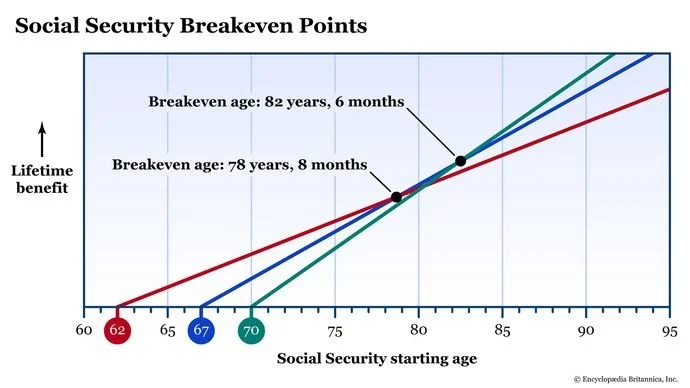
The chart above might demonstrate why thinking about our own mortality before filing can pay off for more people than not. You can see from the chart above that the cumulative benefits received by someone who files at age 62 and someone who files at age 70 breakeven at around age 80. Think about your own health and family history, and ask yourself, “Do I think there’s a better than average possibility I’ll live into my early to mid-eighties?” If the answer to that is yes, then you might be better off deferring.
From experience, math is math, but money is emotional. The idea of a monthly income stream sitting out there, and the future of our own lifetimes and Social Security feeling uncertain, can make it feel like you’re missing out by not filing for and collecting benefits right away. I get it. If that’s the choice you decide to make, you’ll have made it well-informed, and clear-headed.
Spousal Benefits
If you’re married, and your benefits are substantially lower than your spouse’s (or your spouse’s are substantially lower than yours), Social Security has a system to make up the difference.
Spousal benefits allow a lower-earning spouse, whose benefits are less than half of a higher-earning spouse, to receive a benefit to make up the difference. Effectively, they can receive up to half of the higher benefit if their own benefit doesn’t bring them there.
Beware: the higher-earning spouse must have already filed for, and be actively receiving, their own benefit before the lower-earning spouse can collect anything on that record.
It’s also worth knowing that the spousal benefit is always based off of the higher earning spouse’s full retirement (typically, age 67) benefit. The benefit the lower earning spouse receives will never be more than that, and will be reduced if they file before their own full retirement age.
Strategies Lost
When I became an advisor in 2011, there were dozens of potential ways a household could file for Social Security to maximize benefits. As of 2015, many of those strategies have been all but eliminated. But there are still a few ways to be strategic, particularly when there is a significant benefits gap between two spouses, or there is an ex-spouse who is eligible for benefits. This effectively makes deferring benefits the most impactful way to increase benefits, as we’ve previously discussed.
That said, there are a few exceptions that could impact you.
If Your Lost Your Spouse
If your late spouse was eligible for Social Security benefits, and you didn’t remarry before age 60, you can collect a survivor benefit as early as age 60 (or age 50, if you’re disabled). The tradeoff by filing at age 60 is that the benefits will be only 71.5% of your late spouse’s full retirement benefit. But what’s nice is that you can allow your own benefit to grow, completely unaffected by collecting this survivor benefit.
You can also flip this, file for your own Social Security benefit early (age 62 - not 60), and allow the survivor benefit to grow. Your survivor benefit will increase based on the age-based formula.
Deciding which choice is right is a matter of comparing the numbers.
Related: see our free financial resources for widows page
Oops, I Filed Too Early
Fortunately, there’s a fix for this, if it hasn’t been too long since you’ve filed. Form SSA-521 lets you withdraw your application within 12 months of filing, repay everything you've received, and refile later as if the first filing never happened. The downside is that you have to come up with the cash to pay back all of your benefits. But if your circumstances have changed - for example, you decide to go back to work - or you’d just rather allow your benefits to grow, after having a conversation with a friend or advisor (or reading this post), that’s exactly what this option is designed for.
Conclusion
Filing for Social Security is rather straightforward. Except for the occasional surprise, for most people, the process is smooth, and they begin receiving benefits without any issue or delay.
But filing for Social Security without putting any thought into timing (on which the Social Security Administration will not provide guidance) is risky, and can result in hundreds of thousands of dollars in lost benefits over the course of your retirement.
There are other things to consider that we didn’t touch on, including taxation of Social Security benefits, and the impact of earned income on Social Security benefits. Be sure to read about these important topics too. And if you haven’t already, check out our retirement planning education page for topics on retirement income, healthcare, taxes, and more.

Scot Whiskeyman, CFP® and Lindsey Ciarrocca, CMC® are independent, fiduciary husband-and-wife financial planners, serving pre-retirees nationwide. They help people approaching retirement make clear decisions with the full picture in mind. They primarily work widows of any age, and with diligent savers between age 50-60 with $500,000 or more investable assets.
The information on this page is for educational purposes. It should not be construed as financial, tax, or legal advice. Investing involves risk including the potential loss of principal. No investment strategy can guarantee a profit or protect against loss in periods of declining values. Past performance does not guarantee future results. It is not possible to invest directly an index. This material is for information purposes only and is not intended as an offer or solicitation with respect to the purchase or sale of any security. The content is developed from sources believed to be providing accurate information; no warranty, expressed or implied, is made regarding accuracy, adequacy, completeness, legality, reliability, or usefulness of any information. Consult your financial professional before making any investment decision. For illustrative use only.